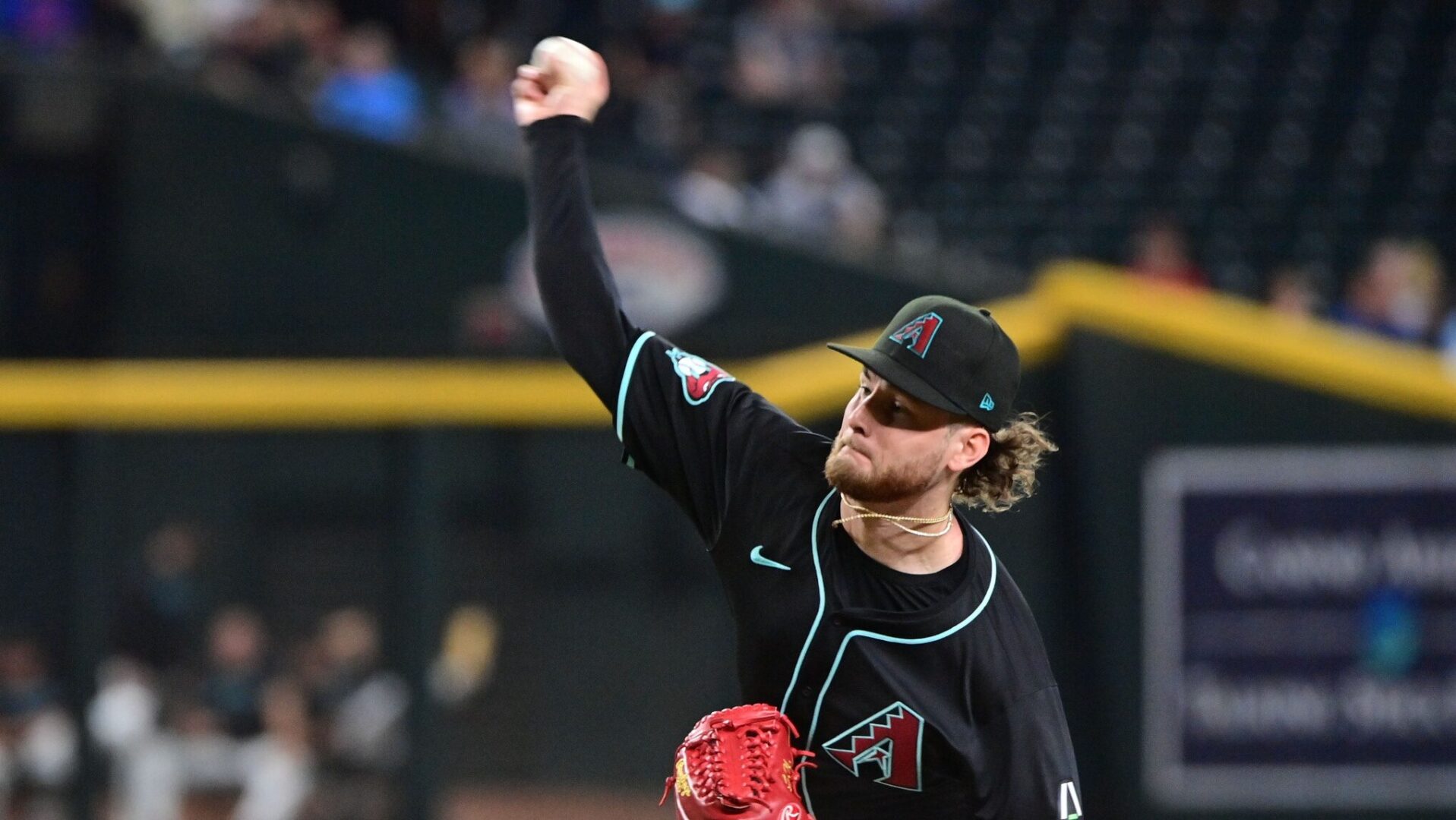
Since the start of July, Ryne Nelson has pitched to a 2.77 ERA over his last 68 1/3 innings. He’s become a key member of the Diamondbacks’ starting rotation, a big reason behind their 37-15 record since June 29. With Nelson’s recent success, the question becomes whether he’s having a legitimate breakout season.
Looking over those past 12 appearances, 11 of them being starts, Nelson has excellent peripherals to back up the good ERA. He boasts a 24.9% strikeout rate compared to just a 4.5% walk rate. Both marks are significantly better than the league average of 22.4% and 8.5%. At the same time, he’s also doing a good job of keeping the ball in the park, with just 0.8 home runs per nine innings pitched. As a pitcher who relies on attacking the top bar of the strike zone with a mid-to-upper-90s fastball, he will give up fly balls and is more susceptible to home runs than a ground ball pitcher would.
Subtracting his walk rate from his strikeout rate, K-BB%, Nelson’s 20.4% rate is the fifth best amongst major league starters with a minimum of 60 innings since July. K-BB% is a great gateway stat to measure a pitcher’s effectiveness, as it assesses the pitcher’s ability to control counts, finish off hitters, and avoid free passes. It also has a lot of stickiness compared to other metrics when projecting a pitcher’s run-prevention skill moving forward.
While there is no metric of a pitcher’s Wins Above Replacement metric on Baseball Reference for a split season, there is one available on FanGraphs. FanGraphs uses FIP (Fielding Independent Pitching), which takes into account a pitcher’s strikeouts, walks, and home runs instead of earned runs to estimate a pitcher’s run-prevention skill independent of defense, in their WAR calculations. Nelson has 2.99 FIP and 1.7 fWAR, which ranks seventh amongst all major league pitchers since July.
With Nelson showing the ability to control counts and the long ball, there’s no longer any doubt that he projects as a starting pitcher in the long term for the Diamondbacks. The next question to ask is how effective a pitcher he’ll be. When trying to project future success for a pitcher, not only is K-BB% a good stat to use, but advanced ERA estimators such as xFIP and xERA are also metrics to consider.
xFIP is a derivation of FIP. Instead of using the total number of home runs, xFIP normalizes the home run total to fly balls times the league average home run per fly ball rate. xERA takes into account the quality of contact plus the strikeout and walk rates of a pitcher before estimating a pitcher’s run prevention numbers.
By both metrics, Nelson has at a 3.32 xFIP and 3.22 xERA since July. Both are excellent marks for a starting pitcher. The Diamondbacks also showed they believe this is a legitimate breakout, as they decided to keep him in the rotation over struggling left-hander Jordan Montgomery for the rest of the season. Despite Montgomery’s past success, Diamondbacks manager Torey Lovullo painted the decision as the need to put his team in the best position to win over the final month of the season.
It will be interesting to see what the Diamondbacks do with Nelson in the postseason if he continues to stack quality starts over the final four weeks of the season. There could be a case for him to start over Brandon Pfaadt in a Game 4 situation, although he profiles better for a relief role between the two.
*Get the BEST Phoenix sports insider information, exclusive content, and access to our seasonal magazines! SIGN UP HERE to unlock our premium content!*
Michael McDermott covers the Arizona Diamondbacks, Arizona Cardinals, and more for Burn City Sports. You can follow him on X via @MichaelMcDMLB